
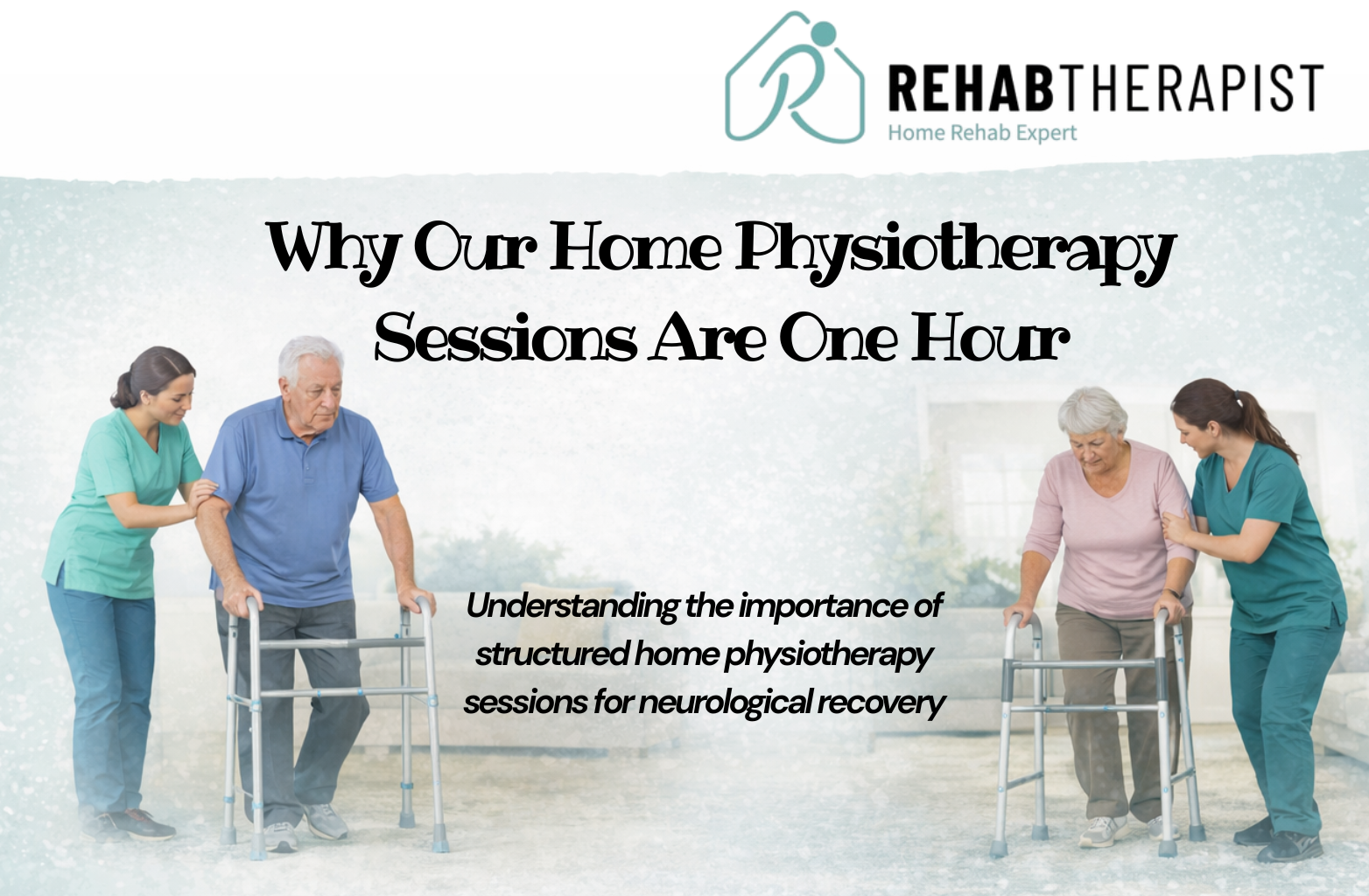
When families first enquire about home rehabilitation, one question often comes up:
“Do we really need a full one-hour physiotherapy session?”
It’s a completely understandable question. Many of the people we support are older adults or individuals recovering from neurological conditions. Fatigue can be a real concern, and at first glance, a shorter session might seem more suitable.
But in practice, the opposite is often true.
At Rehab Therapist, our home physiotherapy sessions are typically one hour long because this allows us to deliver structured, meaningful rehabilitation that genuinely supports recovery. For individuals living with neurological conditions such as stroke, Parkinson’s disease, brain injury, or mobility decline after hospital stays, effective therapy requires time, repetition, and careful pacing.
The Science Behind Rehabilitation Time
Clinical guidelines consistently show that recovery after neurological conditions requires repetition and consistent practice.
For example, stroke rehabilitation guidance recommends several hours of therapy and activity per day where possible. The reason is simple: the brain and body need repeated movement practice to rebuild strength, coordination, and balance.
In a hospital environment, patients may receive several therapy sessions daily. When rehabilitation continues at home, the goal is not to replicate hospital intensity but to ensure each session remains effective and purposeful.
This is why a one-hour home physiotherapy session works best. It allows enough time to deliver exercises safely while adapting the pace to the patient’s energy levels.
Understanding Neurological Fatigue
Fatigue after neurological illness is very different from everyday tiredness.
After a stroke, brain injury, or neurological condition, the brain often needs to work much harder to perform movements that were once automatic. Simple actions like standing, walking, or turning can require far more concentration and effort.
Many older adults also experience deconditioning after hospital stays. Muscles weaken quickly, balance becomes unstable, and confidence may drop.
When someone becomes tired after ten minutes of activity, the solution is not to reduce therapy to ten minutes. Instead, the session needs to be structured with the right pacing and rest periods.
A one-hour session allows us to balance activity and rest safely.
Why 30-Minute Physiotherapy Sessions Often Fall Short
Short physiotherapy sessions may seem efficient, but they often do not provide enough time for meaningful progress.
In a typical shorter session, the therapist needs to:
• Review the patient’s condition
• Check safety and mobility levels
• Begin exercises or walking practice
• Monitor fatigue levels
By the time movement begins to improve, the session is almost finished.
This can leave patients feeling like they have barely started, while families may still have questions about progress and safety.
Rehabilitation should never feel rushed.
What a One-Hour Home Physiotherapy Session Allows
A full hour creates space for a structured approach to rehabilitation. During our sessions, we are able to:
- Pace the therapy safely
- Include natural rest breaks
- Repeat movements to build strength
- Practise transfers, balance, and walking
- Improve mobility and confidence
- Address fall prevention strategies
- Educate families and caregivers
- Adjust exercises for neurological recovery
This approach is particularly valuable for neuro physiotherapy, where repetition and gradual progression are essential.
Real Progress Happens With Time
Consider a typical example.
An elderly patient returning home after several weeks in hospital may initially struggle to stand or walk safely. In a short session, they might manage one or two assisted movements.
In a full hour, the structure can look very different:
• Assisted standing practice
• Rest and recovery
• Balance training
• Short walking practice
• Further repetition after rest
By the end of the session, many patients achieve far more than they expected. Often the response is:
“I didn’t think I could do that today.”
That is the difference proper time makes.
Myths About Physiotherapy Session Length
There are several common misconceptions about therapy sessions.
Myth: Shorter sessions are better because elderly people get tired soon.
Reality: Fatigue can be managed within longer sessions using pacing and rest breaks.
Myth: Physiotherapy is just exercise.
Reality: Rehabilitation includes education, balance training, movement practice, and confidence building.
Myth: Less activity protects recovery.
Reality: Safe, repeated activity helps rebuild mobility and independence.
Why Home Neuro Physiotherapy Requires Careful Structure
At Rehab Therapist, we specialise in home-based neurological physiotherapy and elderly rehabilitation. Many of the people we support live with conditions such as:
• Stroke recovery
• Parkinson’s disease
• Brain injury rehabilitation
• Balance disorders
• Mobility decline after hospitalisation
• Age-related weakness and falls risk
For these conditions, therapy must be delivered carefully within the home environment where daily life actually happens.
Home sessions allow therapists to work on real-world movement challenges, such as:
• Getting in and out of chairs
• Walking safely around the home
• Climbing stairs
• Preventing falls
• Building confidence with mobility aids
This practical approach is one of the biggest advantages of home physiotherapy services.
It’s Not About Filling Time — It’s About Using Time Well
Families sometimes worry that a one-hour session may feel too long or exhausting. In reality, the session is carefully structured with rest periods and adapted exercises.
A well-paced session often leads to:
- Improved balance
- Safer walking
- Greater confidence
- Reduced risk of falls
- Increased independence
- Better long-term recovery outcomes
When therapy is rushed, progress tends to slow down. When therapy has enough time to be delivered properly, the results are often much stronger.
A Clinical Perspective From Years of Experience
After many years working in neurological physiotherapy and elderly rehabilitation, one thing remains clear.
Meaningful rehabilitation takes time.
Not excessive time.
Not an exhausting time.
Just enough time to work, rest, repeat, and progress safely.
That is why our home physiotherapy sessions are one hour. It allows therapists to deliver care in a calm, structured way that supports real recovery.
At Rehab Therapist, our goal is simple: to help people regain mobility, confidence, and independence in their own homes.
And one hour gives us the space to do that properly.
